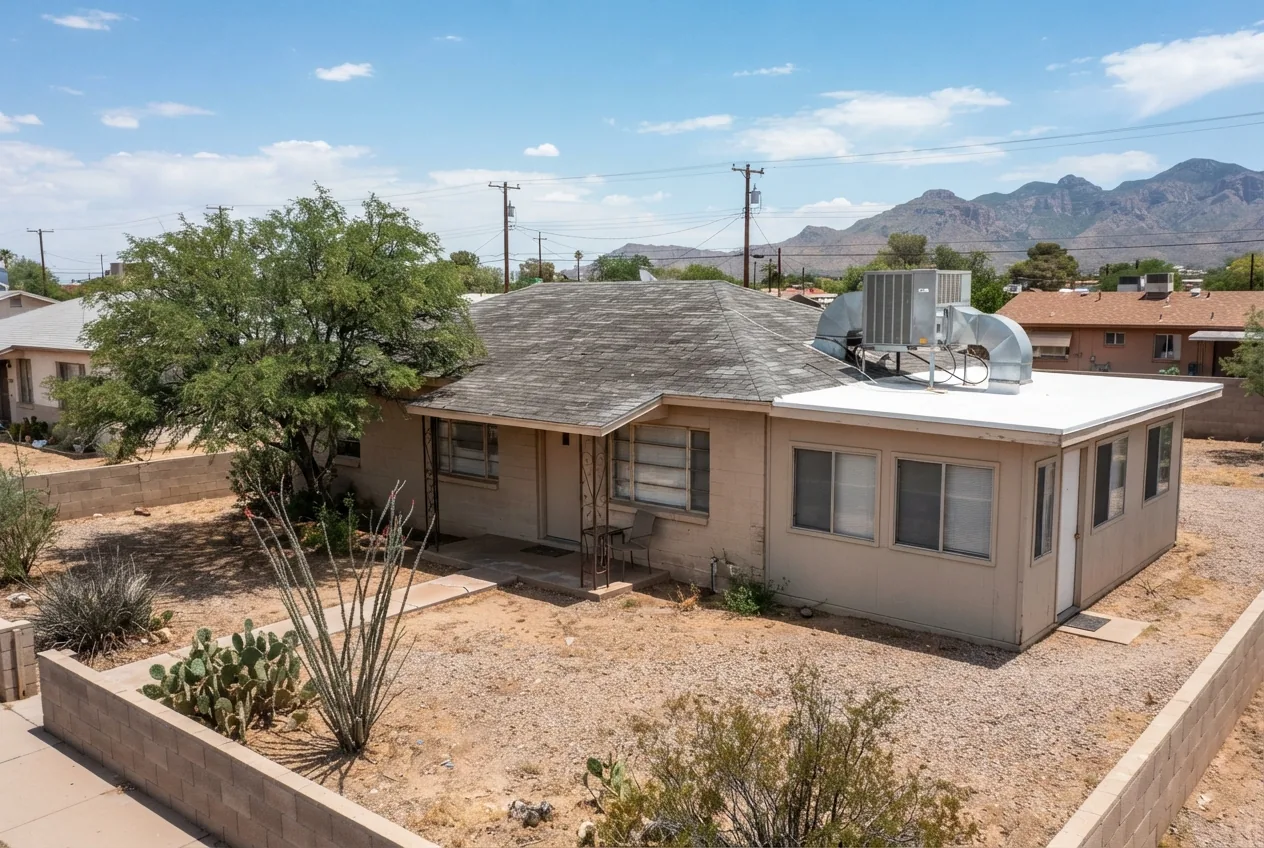
Plenty of older Tucson homes don't have one roof. They have three or four. The original house got an Arizona room in the 1970s, a carport got enclosed in the 1980s, and somebody added a back bedroom after that. Each addition brought its own roof, often a different pitch and a different material, and every place those roofs meet is a seam. Seams are where leaks like to start.
Why the Seams Leak
The joint between an original roof and an addition has a few things working against it:
- Different slopes. A pitched main roof often meets a flat or low-slope addition. Water coming off the steeper roof lands on the flatter one, and if the flatter roof can't shed it fast enough, it sits.
- Different materials. Shingle or tile on the main house, a coated flat roof on the addition. They expand and contract at different rates in the heat, and the joint between them takes the stress.
- Different builders and different decades. The flashing at that joint was often done by whoever built the addition, with whatever was standard at the time. It may not have been touched since.
- Roof-to-wall transitions. Where a lower roof runs into the wall of a taller section, the flashing has to turn a corner and tuck behind the wall surface. When it pulls loose or cracks, water runs down the wall and straight in.
Low-Slope Sections Need More Upkeep Than People Expect
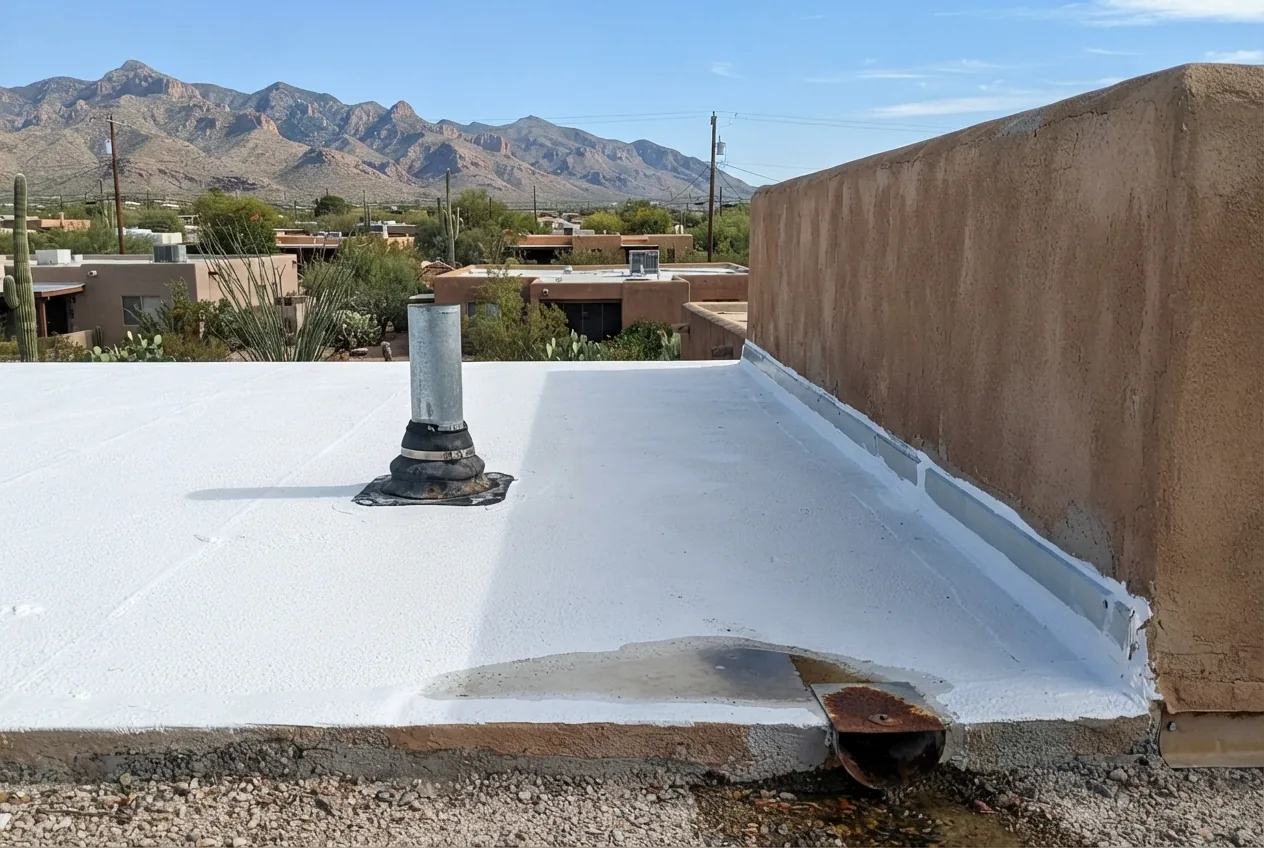
Flat and low-slope roofs on Arizona rooms and carports are usually covered with a coating or a membrane rather than tile or shingle. Those coatings don't last forever in desert sun. Most need to be renewed every several years, and a lot of homeowners have no idea when theirs was last done. Common warning signs include cracking or "alligatoring" across the surface, a chalky residue, bare spots, and water that stands for days after a storm.
Ponding matters because standing water finds every weak spot in an aging coating, and it adds weight. If a low section holds puddles long after the rest of the roof is dry, that's worth a closer look before the next monsoon.
Monsoon Season Puts the Seams to the Test
Tucson's monsoon doesn't deliver its rain gently. According to the National Weather Service's Tucson office, the city's normal monsoon brings about 6 inches of rain, but individual seasons have ranged from about 1.6 inches to nearly 14. Much of it comes in short, heavy bursts driven by wind. That combination pushes water sideways into joints that a slow rain would never reach, which is why so many addition leaks only show up in July and August.
How to Narrow Down Where It's Coming From
You don't need to climb on the roof to gather useful clues. In fact, it's safer not to, especially on an older low-slope section that may not be built for foot traffic.
- Note where the stain is relative to the addition. A stain along the wall where the Arizona room meets the house points to the transition flashing. A stain in the middle of the addition's ceiling points to the roof surface itself.
- Note when it leaks. Only in wind-driven storms suggests flashing or a seam. Any time it rains suggests a hole or failed coating.
- Check from the attic if you can do it safely. Look for water staining on the wood where the old and new framing meet.
- Look for anything that goes through the roof nearby. Rooftop coolers, vent pipes, and skylights near a seam are common culprits. The rubber boot seal around a rooftop evaporative cooler is a frequent leak source on older homes.
- Look up at the trees. Branches that rub the roof or drop debris into the low spot where two roofs meet make every one of these problems worse.
Repair the Seam, Not Just the Stain
The common mistake is patching the spot directly above the ceiling stain. Water travels, especially along the joint between two roofs, so the entry point can be several feet from where it drips. A proper fix traces the water back to where it gets in, then rebuilds the flashing at the transition, repairs or recoats the low-slope surface, and seals any penetrations nearby.
Older neighborhoods are full of these layered roofs. Neighborhoods built from the 1950s through the 1970s on Tucson's southwest side are a good example, and this neighborhood guide to the streets around Winston Reynolds-Manzanita Park shows how common additions, rooftop coolers, and flat sections are on homes that age.
If your home has an addition and a leak you can't pin down, a licensed roofer who will walk both roofs and the joint between them, and show you photos of what they found, is worth far more than another patch on the ceiling.